Showing posts with label moon. Show all posts

Monday, February 20, 2012

Infinity and Beyond !

My following article appeared on Tribune Blogs on 19th Feb 2012. Thanks to my editor for choosing such a good title. my original title sucked :D

July 21, 1969 was seen by many as the culmination of man’s evolution from a cave-inhabiting savage to an astronaut. That landing on the moon owed more to the imagination overdrive of the Western civilization than the technological advancements of the time. Looking at it from a purely economic point of view, it would be safe to say that space programs around the world have introduced spin-off technologies that have actually sped up human technological evolution and had a major impact on our daily lives.


Now let us descend from the lofty heights of the western civilisation’s achieve

ments in space and have a look at our own space program. Having relatively encouraging beginnings, our national space program was the brain child of Dr Abdus Salaam and with our test two-stage space rocket firing on June 7, 1961, Pakistan became the third Asian country and the 10th in the world to achieve this milestone. And as time progressed, Pakistan launched a couple of satellites into space including Badr1, PakSat-1 and 1-R. Although it is commendable that we have at least a presence in space, our enthusiasm must not end here.

At present, it seems that SUPARCO, while functioning to meet standard requirements of remote sensing, mapping and satellite communications, is missing the fabled ‘spark’ that might make it an economic pillar of the country rather than being a docile space agency that relies on Chinese technology and launching sites .

It seems that the government, corporate institutions and the common people have not yet fully realised the importance of space sciences for a country’s economy. An effective and active space program can help boost a country’s economy in more ways than anticipated. There are uses of space technology in agriculture, medicine, GPS, and many other areas. The enriched baby food used today owes its origins to NASA, from back in the days of the Apollo missions. It doesn’t take an economist to realise that the spin offs from space missions like the Apollo missions have resulted in the growth of several multi-billion dollar industries from which the USA has benefited incredibly. Scott Hubbard, former NASA scientist, now working at Stanford University, notes that for every 1 dollar invested in NASA projects $7-8 worth of goods are produced in the industry. precious few satellites into space and renting already orbiting satellites ( like Pak Sat-1). Its budget is less than even Ukraine, Belgium or Iran’s space agencies and competition with India’s ISRO is hopelessly out of the question at the moment. Concerning space sciences, Karachi University’s space sciences

institute ISPA is suffering from neglect, so much so that the class rooms have broken light bulbs, the whole facility is running on generators and the only “powerful” telescope provided is malfunctioning and hopelessly obsolete – I wish that was an exaggeration.


The future of earthlings lies out there in space. Now, one might argue that Pakistan already has enough expenses on its plate without adding space exploration expenditures to the list. However, if we don’t catch up with the changing times then we might be left woefully behind. India has already sent an unmanned spacecraft to the moon and is on its way to becoming a major space power, leaving Pakistan to squabble with the US and Afghanistan over petty issues and countering home grown fundamentalism.

The question is not about whether Pakistan should takes giant leaps in advancing its space program but about whether Pakistan would be economically able to stand in the comity of nations. Is our entrepreneurial spirit so dead that we can’t even imagine the possibility of Pakistan’s space age? Recently I wrote a blog about putting a Pakistani on the


moon. Ludicrous though it sounds, the purpose of that article was to observe the imaginative power and the entrepreneurial zeal of my fellow Pakistani readers. Many blog sites in the Pakistani blogdom refused to even publish that (except for a couple). It makes me wonder if Jules Verne was denied publication rights to Journey to the Moon (a century before the Apollo missions) by the French, just because it was highly ludicrous. It is that imaginative power and spirit – not squabbling over vague religious doctrines – that propels nations to excel in economics, science and technology.

Currently the Pakistani space program comprises of:

- Satellite Development Program Remote Sensing & GIS Applications,

-Space Science,

- Core Technologies Development,


- International Cooperation & Infrastructure Development.

The satellites that are in operation are Pak Sat-1, Pak Sat1-R, and the Badr Series satellites. Suparco has planned to launch an optical imagery satellite soon and a high resolution remote sensing satellite by the year 2014. These plans are integrated within the Space Program 2040, whose purpo


If there is a time for Pakistan to make a giant leap then now is that time. With a stagnant space administration, lack of education and research in space sciences, if we can overcome the institutional barriers to stop us from succeeding there is nothing to stop our minds.se is to present the full benefits of space technology to the nation. As commendable as these steps may be, an active effort still has to be made to make the public aware of these achievements. A crop of scientists and engineers has to be cultivated so that the future growth of Pakistani space program is not moribund. Since Suparco is still dependent on Chinese and Russia

n technology to develop satellite, communication and launch systems, to launch a truly indigenous satellite and space vehicle efforts have to be made to promote s

pace technology in our schools, universities and colleges. If we can build sophisticated weapons of mass destruction, why not use the same technologies in areas of science and technology.

If Pakistan is to survive for a thousand years then the time for developing a comprehensive space exploration strategy is now!

Monday, January 16, 2012

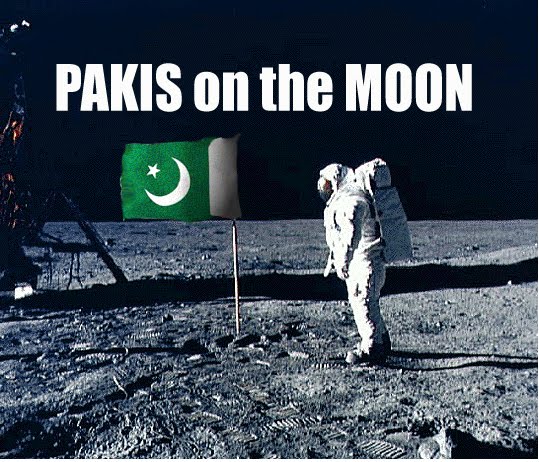
Putting a Paki on the Moon


The soil that we tread on is a great witness to the evolution of humanity, from caves to the high-rise buildings of cold metal and hard brick. These sand particles and the pebbles have borne the footsteps of Prophets, Messiahs, Writers, Inventors, Conquerors and Philosophers. They have seen what we have not seen, for we the humans mostly tend to forget what we did in the past and what are we capable of doing.
As I tread on a small pebble strewn path near my university under the night sky, I look up at the crescent above me. It is comforting to feel earth’s closest space neighbor’s cool bluish light on me. As I look up, I can’t help but focus my eyes on a patch of moon where Neil Armstrong and Buzz Aldrin landed. That first step on 20th July 1969 was the epitome of USA’s advancement in science and technology. No other country has done it since the Apollo missions and it is unlikely to repeat that feat for another two or three decades.
Then a very crazy thought entered my head, but the thought was ridiculous, verging on blasphemous. I ignored it and continued my nighttime walk.
I came back and tried to forget what I had just thought but the thought somehow stuck. Then another thought came in. This one more ridiculous than the other. I laughed at it, this second thought was to write down and share the first thought that had come in my head. I told myself that if I ever write it down I would be branded as a “Lunatic” ( ah the irony of words).
But then my mind is like PM Gillani and my thoughts like Zardari. The former always succumbs to the pressure exerted by the latter. So here I am, penning out what I had thought that night.
Pakistan needs a Man on the Moon.
Now go on laugh, of course I can’t blame you, can I ? How can a nation suffering from electricity and gas shortages, strikes, war, death and destruction, who doesn’t (apparently) has money to build even a dam can ever EVER dare to hope to put a man in space let alone the moon. It seems like disrespect, mocking if you like, to the sufferings of a nation consisting of 180 million souls, 63% of whom fall under the age of 25 and where the literacy rate hovers somewhere around 50% and whose population still believes that Neil Armstrong really did hear Azan on the moon despite the fact that sound needs air to travel-And there’s no air on the moon!
But, just bear a few moments with me and imagine, what would it be like to have the Pakistani flag on the lunar surface. Wouldn’t it be exhilarating? Wouldn’t it be just a pleasure to show your passport on the airport and not have eyes brows raised but be greeted with a smile because you belong to a nation that had just conquered the moon from the Americans, to have the world label you as bold space entrepreneurs rather than as a nation of conservatives and blowhards. To think that the world would be a better place with the achievement of a crippled nation sending a man to the moon and ushering the world into a new space age seems like stuff from a Hollywood movie. But allow me to make an argument here. If a nation with a literacy rate of 50 % can make cruise missiles, a nation where a sewing needle is imported from China can make a nuclear device, a nation where half the population can’t even afford a computer, can boast world’s youngest Microsoft certified professionals, cannot build a rocket and lunar vehicle to take a man to the moon, I would say you are kidding me.
When we spend more than 43 billion dollars in fighting “our own people” for some nation thousands of miles away from us, when we spend more than 60 million dollars to help those affected by the war on terrorism, when our military budget increases with each passing year, where the security expenses of the PM and the President per annum alone surpass the 500,000 dollar figure and then you tell me we can’t afford to put a man on the moon. I say you sir are kidding me.
It is at times like these where nations can either rise or sink. Just like that tight ropewalker about to jump to safety after walking the whole length can either slip and fall or safely step on the ledge and take a bow, imagine Pakistan to be that tight ropewalker. Albeit, small, emaciated, starved, crippled and limping. I say costs don’t matter. What matters is the will of the people to leave a mark on history. That’s a common feeling that’s shared by people who believe in team effort, who believe that no matter what, obstacles can be overcome. Nations like these are powered by the almighty trinity of Youth, Intellectuals and Military. And believe you me. Pakistan has that. Just think, how much Pakistan can gain in technology when its every engineer would be involved in the lunar mission, imagine the number of technologies that would be introduced, the billions of foreign investment, new management practices, newly emerging centers of Pakistani economy, explosion of educational institutes, the flood of engineers and entrepreneurs, Pakistan would be changed forever and with it the South Asian region, or may be the whole world itself. Pakistan’s name would become a by word for heroism, adventurism , inspiration and motivation. When schoolchildren will read poems about the Pakistani mission to the moon rather than King Bruce and the Spider.
Imagine a day when every Sindhi, Balochi, Pashtun, Punjabi, Sunni, Shia, Barelvi, Ahmadi, Wahhabi, would be looking at that shiny sphere in the sky, as one single entity all thinking the same thing:
“Has it landed yet?”
Number of Visitors