Should I put this person’s name in my report who is
suffering from illness which might cause him embarrassment in his public
life? Should I identify this person in my article which might make him
vulnerable to
slurs? These are the questions which any responsible journalist must ask
before publishing reports on issues relating to gender, sexuality,
health and abuse. In Pakistan specifically, it is essential for a
journalist to guard a victim/patient/gender’s identity
due to the fact that we as a society still live in the seventh century
when it comes to recognizing LGBT
rights, stigmatizing rape victims and gossiping about a person’s
illness. Can a person with a sexual disease
ever come out without being judged and comments passed on him/her
because of imagined sexual indulgences? Can a rape victim come out in
the open without being told that the DNA evidence in her/his case is
unacceptable according to Council
of Islamic Ideology? In a country where 60% of the people surveyed, would not like to be friends with a transgender,
a journalist must make his/her top priority
not to reveal names when doing reports on these kind of stories. The
5-year old girl raped in Lahore should never have been named in the
first place, but ratings and sensationalism continue to have a vice like
grip on our media. Wednesday, October 23, 2013
Dear ET, Try keeping it confidential !
Should I put this person’s name in my report who is
suffering from illness which might cause him embarrassment in his public
life? Should I identify this person in my article which might make him
vulnerable to
slurs? These are the questions which any responsible journalist must ask
before publishing reports on issues relating to gender, sexuality,
health and abuse. In Pakistan specifically, it is essential for a
journalist to guard a victim/patient/gender’s identity
due to the fact that we as a society still live in the seventh century
when it comes to recognizing LGBT
rights, stigmatizing rape victims and gossiping about a person’s
illness. Can a person with a sexual disease
ever come out without being judged and comments passed on him/her
because of imagined sexual indulgences? Can a rape victim come out in
the open without being told that the DNA evidence in her/his case is
unacceptable according to Council
of Islamic Ideology? In a country where 60% of the people surveyed, would not like to be friends with a transgender,
a journalist must make his/her top priority
not to reveal names when doing reports on these kind of stories. The
5-year old girl raped in Lahore should never have been named in the
first place, but ratings and sensationalism continue to have a vice like
grip on our media. Tuesday, September 3, 2013
The Syrian Bear Trap Part 2.
“He has proven instead only his contempt for the United Nations and for all his pledges. By breaking every pledge, by his deceptions and by his cruelties….”You might be thinking that this is an excerpt from an Obama press conference citing the reasons for a strike against Bashar al Assad’s Syria. Yet, these words were spoken by George W Bush at the United Nations on 13 September 2002, and the above quote ends with…,
“Saddam Hussein has made the case against himself.”Some things never change.
With the UN weapons inspectors pulling out of Syria with the “possible” evidence of chemical attacks, it seems that the US is hell bent on attacking Syria and “punishing the country for using chemical weapons”. It must be noted that the weapons inspectors would only have evidence concerning the occurrence of chemical attack and not who did it. This leaves the field open for the US to assert its “moral authority” to attack Syria based on its own “reliable” intelligence. The possible US attack on Syria would again throw the region into geopolitical turmoil the likes of which can only be matched by the Iraq invasion disaster.
But the US is not alone. France –fresh and confident from its adventures in Mali and
Libya- is ready to assist the US in “punishing” Syria for using
chemical weapons. The UK’s parliament has thankfully voted against any
intervention.The American public, in a latest poll, has voted against any intervention in Syria. 53% say that they are against US military intervention in Syria, though it must be acknowledged that the numbers were higher in the previous week (60%). Even the officers in the US military have doubts regarding the wisdom of attacking Syria when they are already coping with the economic and military battering that the US has received from both Iraq and Afghanistan. The Iranian and Hezbollah threat is always present. Thus, the case against any intervention in Syria is strong.
So why is the American administration hell-bent on engaging in another military adventure which nearly everyone thinks will probably end like another Afghanistan?
The answer can be sought in the preparations that the jihadis in Syria are making for the coming American strike. Many jihadist organisations are shifting bases, evacuating headquarters, moving equipment and even finding safe hiding places in the mountainous terrains. They think that the coming US attack would also be aimed at jihadist organisations that control vast swathes of land in the northern and eastern provinces of Syria. In a statement, the jihadi outfit Fatehul Islam has said that,
“For every US missile that hits a regime target, another will strike a jihadi base.”The bread and butter of any standard jihadi outfit depends on how well it fights and speaks against US hegemony. This might be a heaven sent opportunity for the jihadis to entangle the US in another war.
It must be asked that who will benefit if the US destroys President Assad’s military strike capability.
The only winner in that case would be Jabahat-al-Nusra and other jihadi outfits who have travelled all across the world to take part in the war. Indeed, it is now becoming increasingly evident that if President Assad falls and when the Syrian civil war is over and done with, Jabahat al Nusra would eventually fall out with Free Syria Army (FSA) (endorsed by the US and NATO and is the official rebel army in Syria) and with seasoned fighters coming from Iraq and other neighbouring battlefields, it would eventually succeed in stopping the FSA from gaining further power and quite possibly open the way for bringing the Syrian war into Iraq against the Shiite government over there, led by Nouri Al Maliki. The Syrian war would spill all over the middle-east and the chemical weapons that Assad allegedly possesses might fall into very wrong hands.
This might be reason as to why the US wants to have a presence in Syria; to stop the jihadists from gaining any further control and chemical attacks were only an excuse. Other than that, we only have the “USA has a moral duty” explanations, and no one in the post-World War II history has ever bought that.
The US might find itself caught in a bear trap that it laid for the Soviets.
This blog of mine was published on Express Tribune on August 31, 2013. http://blogs.tribune.com.pk/story/18694/the-us-war-on-afghanistan-is-over-syria-is-the-new-project/
Monday, February 20, 2012
Infinity and Beyond !
My following article appeared on Tribune Blogs on 19th Feb 2012. Thanks to my editor for choosing such a good title. my original title sucked :D
July 21, 1969 was seen by many as the culmination of man’s evolution from a cave-inhabiting savage to an astronaut. That landing on the moon owed more to the imagination overdrive of the Western civilization than the technological advancements of the time. Looking at it from a purely economic point of view, it would be safe to say that space programs around the world have introduced spin-off technologies that have actually sped up human technological evolution and had a major impact on our daily lives.
Now let us descend from the lofty heights of the western civilisation’s achieve

ments in space and have a look at our own space program. Having relatively encouraging beginnings, our national space program was the brain child of Dr Abdus Salaam and with our test two-stage space rocket firing on June 7, 1961, Pakistan became the third Asian country and the 10th in the world to achieve this milestone. And as time progressed, Pakistan launched a couple of satellites into space including Badr1, PakSat-1 and 1-R. Although it is commendable that we have at least a presence in space, our enthusiasm must not end here.
At present, it seems that SUPARCO, while functioning to meet standard requirements of remote sensing, mapping and satellite communications, is missing the fabled ‘spark’ that might make it an economic pillar of the country rather than being a docile space agency that relies on Chinese technology and launching sites .
It seems that the government, corporate institutions and the common people have not yet fully realised the importance of space sciences for a country’s economy. An effective and active space program can help boost a country’s economy in more ways than anticipated. There are uses of space technology in agriculture, medicine, GPS, and many other areas. The enriched baby food used today owes its origins to NASA, from back in the days of the Apollo missions. It doesn’t take an economist to realise that the spin offs from space missions like the Apollo missions have resulted in the growth of several multi-billion dollar industries from which the USA has benefited incredibly. Scott Hubbard, former NASA scientist, now working at Stanford University, notes that for every 1 dollar invested in NASA projects $7-8 worth of goods are produced in the industry. precious few satellites into space and renting already orbiting satellites ( like Pak Sat-1). Its budget is less than even Ukraine, Belgium or Iran’s space agencies and competition with India’s ISRO is hopelessly out of the question at the moment. Concerning space sciences, Karachi University’s space sciences

institute ISPA is suffering from neglect, so much so that the class rooms have broken light bulbs, the whole facility is running on generators and the only “powerful” telescope provided is malfunctioning and hopelessly obsolete – I wish that was an exaggeration.
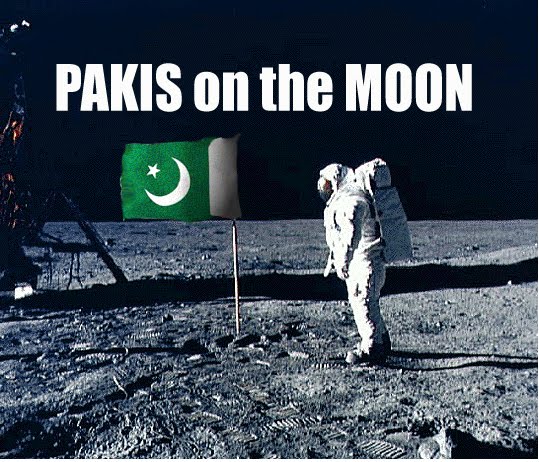
The question is not about whether Pakistan should takes giant leaps in advancing its space program but about whether Pakistan would be economically able to stand in the comity of nations. Is our entrepreneurial spirit so dead that we can’t even imagine the possibility of Pakistan’s space age? Recently I wrote a blog about putting a Pakistani on the

moon. Ludicrous though it sounds, the purpose of that article was to observe the imaginative power and the entrepreneurial zeal of my fellow Pakistani readers. Many blog sites in the Pakistani blogdom refused to even publish that (except for a couple). It makes me wonder if Jules Verne was denied publication rights to Journey to the Moon (a century before the Apollo missions) by the French, just because it was highly ludicrous. It is that imaginative power and spirit – not squabbling over vague religious doctrines – that propels nations to excel in economics, science and technology.
Currently the Pakistani space program comprises of:
- Satellite Development Program Remote Sensing & GIS Applications,

-Space Science,
- Core Technologies Development,
- International Cooperation & Infrastructure Development.
The satellites that are in operation are Pak Sat-1, Pak Sat1-R, and the Badr Series satellites. Suparco has planned to launch an optical imagery satellite soon and a high resolution remote sensing satellite by the year 2014. These plans are integrated within the Space Program 2040, whose purpo

n technology to develop satellite, communication and launch systems, to launch a truly indigenous satellite and space vehicle efforts have to be made to promote s
pace technology in our schools, universities and colleges. If we can build sophisticated weapons of mass destruction, why not use the same technologies in areas of science and technology.
If Pakistan is to survive for a thousand years then the time for developing a comprehensive space exploration strategy is now!
Tuesday, January 31, 2012
The Great Brain Waste
My following article also appeared on Express Tribune Blogs
In May last year an Australian embassy press release stated that more than 5,000 Pakistani students have chosen Australia as their destination to study.
How many of these people actually go abroad to study?
The answer is nil.
Living in Australia, I can say that 99% of these so-called students are actually professionals and underachievers of society who go abroad to seek a better life. Let’s face it: who would want to live in a country where there is daily load shedding, nepotism, corruption, government ineptitude and terrorism, right?
Although this Pakistani talent is moving out in search of greener pastures, the truth is that most of it is being put to use in cutting tomatoes for restaurants, driving taxis and cleaning toilets. This phenomenon is known as brain waste.
According to the Encyclopedia of World Economy , brain waste is defined as the underuse of migrant talent in the host country. In the same encyclopedia, which quotes Ozden’s 2006 study, it is mentioned that the brain use of Pakistani migrants is just 38%
The problem is that the toilet cleaner or that person who chops veggies in restaurants is a highly educated man or woman who might possess a masters or bachelors degree but can’t get a decent job. Misconceptions about race and religion are also important factors for Pakistanis being jobless or being caught in sub-standard jobs in the West.
Another important and closely related problem is the under utilisation of Pakistani talent. This means that even if you get a decent job in a high-rise building abroad, you will still face a barrier during job promotions and other office activities. This talent is being wasted in a foreign country. It should really be put to good use in Pakistan. This is why the brain drain in Pakistan and the subsequent brain waste are co-related. Hundreds of Pakistani doctors, engineers and IT professionals are working in super markets, packaging factories and restaurants abroad.
Many Pakistani students go away merely to secure a nationality. They do not even bother to show up for classes during the semester and appear only at the time of exams. After my recent encounters with some of these students, I realised that most are here in a foreign country to secure a better future for their families by sacrificing their own. Sadly, these people add nothing to the knowledge of the host country and finally become parasites. The labour that could have been done by any other common person is now being done by our doctors, scientists and engineers.
Recently, I met a former government teacher from Punjab who after being frustrated by low salaries moved to Australia to work in a kebabshop. All he wants is to earn enough money to move back to Pakistan and open a restaurant in five years, so that he and his family can live “happily ever after”.
After witnessing the government’s legendary acts of corruption, who can convince that poor teacher not to leave his job and pursue a career which is unsuitable for him? The truth is that Asians generally choose their careers on the basis of a given situation and not their talent. Hence, Pakistan which already faces a shortage of teachers, is short of one more.
Who knows how many other doctors, engineers and scientists will leave Pakistan to be contractors, taxi drivers and restaurant owners at the expense of their true skill?
Unfortunately, these talented and highly skilled individuals will remain unutilised unless something substantial is done to stop this brain waste and restore normalcy in the state of Pakistan.