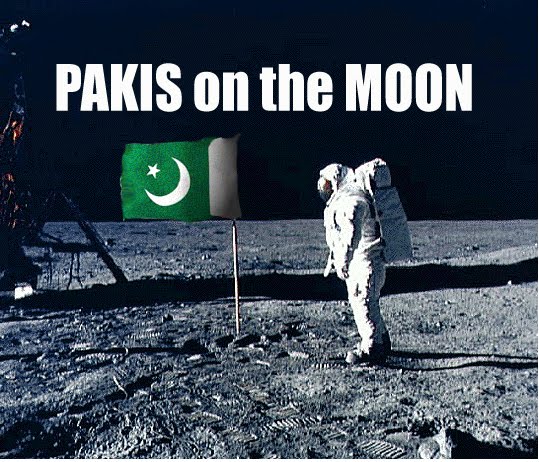
In 1961 when our only Nobel laureate Dr. Abdus Salam and Commodore WJM Turowicz were busy laying down the foundations of SUPARCO, little they might have thought that 52 years later, the nation’s space agency would either, still be renting foreign built satellites or else hitchhiking on foreign rockets to launch indigenously built satellites into space.
.jpg)
The beginnings of SUPARCO reflected the dreams and goals of its founders and the scientists involved. Frequent rocket tests, collaborations with NASA regarding training of Pakistani scientists and engineers, and with keen government interest in the field, one might have had guessed that within a decade or two we would be sending our own satellites into space using indigenously built rockets. But then Dr. Salam was shunned by the Pak government, collaborations with NASA stopped, government lost interest and ever since that time SUPARCO seems to exist just because it has to, without any entrepreneurial zeal, devoid of innovation and lacking a clear cut direction.
Currently, SUPARCO is undertaking programs relating to communication satellites, remote sensing, geo graphic information systems and space studies. It provides services in land surveying, crop monitoring, vehicle tracking systems etc. Its customer base is diverse; ranging from the Kutchi Abadi Authorities toPakistan Railways. Also in its Space Program 2040-approved by Ex-Pm Syed Yousuf Raza Gilani- it plans on producing and launching its own satellites by the year 2040.

But is that it? Will our satellite system be only focused on crop monitoring, land surveys and tracking? Where’s the vision in it? The services that SUPARCO provides are a staple in any standard space agency-there is nothing special in that. Also, achieving indigenous satellite production and launch capabilities and that too by 2040 speaks volumes about the ‘vision’ that is set by SUPARCO. When right now, our neighboring countries are sending probes to mars and beyond, achieving the ability to develop and launching satellites by 2040 is just not enough!
We have to realize that a well functioning space program is crucial to the development of a nation. From enriched baby food to solar panels used in homes, there have been many commercial spinoffs from the technologies that were originally intended to be used in space. Space Technology development does not only benefit one particular branch of science but is equally beneficial to an economy as well. According to former NASA scientist, Scott Hubbard, for every 1 dollar invested in NASA projects $7-8 worth of goods are produced in the industry!
SUPARCO now has to take on a more active role and its vision 2040 should really be vision 2020. It has to work on increasing coordination with schools colleges and universities so that a crop of future engineers and scientists are motivated, and their skills honed. The government has to pay more attention to SUPARCO regarding its developmental projects. As Antoine St. Exupery once said,
“If you want to build a ship, don't drum up people to collect wood and don't assign them tasks and work, but rather teach them to long for the endless immensity of the sea”.
Thus, the government along with SUPARCO should undertake initiatives to educate public about space sciences in a way that they understand in order to build popular support
Dear readers, Space programs not only satisfy human desire to explore the universe but also create thousands of jobs; jobs that are certainly not limited to engineering only but spill over to diverse fields, ranging from textiles to psychiatrics.
The shambles in which European and USA economies are in right now means that the stage for the next space race would be set in Asia, aided and abetted by western companies who have the expertise but lack funding support from their respective governments. Indeed China and India are making significant progress in space exploration; the former is planning to send manned missions to the moon while the latter is sending a space probe to Mars by November.
The development of an ambitious space program would not only benefit Pakistan in the military field, but will also create an air of innovation and ideas that will cross-pollinate many separate scientific and business disciplines.
Nevertheless, we face the daunting task of tackling our domestic terrorism and political issues in parallel to the development of a proper space program and that requires not only a visionary leadership but also entrepreneurs who are ready to propel us into the future.
This is not the time to lag behind. The next space race is ‘on’ in Asia and we have to be a part of it, otherwise we would be left very far behind, even farther than we are right now.