Saturday, March 31, 2012

To Mourn the Death of a Political Activist

On 27th March, “unidentified persons”, shot dead an MQM activist, within hours of the incident numerous buses, hotels and shops were set ablaze and several casualties were reported in the aftermath of the killing. Then on 29th March, some ANP activist was killed by some “unknown people”.

Those people who think that setting ablaze shops and buses would somehow quench their thirst for vengeance, are wrong, it is not right. It is never right, by any law, by any code or by any moral standard to injure and maim people in vengeful anger and the political parties are utterly and entirely to held in blame for this carnage.

These knights of vengeance forget that when they set about to avenge the death of their comrade, the people would only mourn for the loss of their own personal property or worse their loved ones. Just for the death of two political activists, 7 Karachiites were killed,

is there any justification for that?

I ask you, how many of us actually shed a tear for the death of a political party of any standing. Majority of us do not, because we have other important things to do in life, struggle to earn bread for the family, study for exams or look after kids. Well, if we don’t care as a nation then why does the ticker on the news channels reads like, “ aaj------kay karqun ki halaqat kay sog per Karachi main shutter down hartal”, so are these news channels telling me that the Karachiites are shutting down their businesses and educational institutions as a protest?

As a consequence of strikes and shutter downs Pakistan suffers a loss of 15 billion rupees and Karachi alone suffers a loss of almost 2.5 billion rupees.

Would a hard-pressed shopkeeper actually even think of closing down his shop for a day just because some activist died?

Would a day laborer actually sit at home as a protest against the target killing of some obscure political activist?

Would a CEO actually think of bearing a loss on revenue for a day just because a political activist died?

No, nobody ever does that, except of course the political parties. How can I think of mourning the death of a political activist of any party when my city burns, when my city loses billions of rupees, just because of political chaos? How can shed I tear for those dead activists when innocent patients cannot get treatment because nurses and doctors fail to turn up at the hospital as a result of the strike. How can I grieve the death of those activists, when a day laborer is unable to feed his family because he could not go out to earn money, just because “some political workers died”.

No, in all honesty and sincerity, I would not grieve, mourn, or protest against the death of the political activist if it means chaos and carnage in my city.

We are much intelligent beings then what we consider ourselves to be. As intelligent beings, God has given us brains to analyze and process complex thoughts, surely we can figure out better ways of protesting, but no, we have to kill, maim and torture our own people to avenge the death of our comrade in arms. All I can say is that the Quaid would be disgusted.

Tuesday, March 20, 2012

Why I want the Quaid's Picture be Removed from the Currency Note‏


Before I begin my article, there are two important definitions that I want to lay down before you:

1) Founding father: defined as a person who starts or helps to start a movement, institution or a revolution.

2) Institution: An established custom, law or behavioral pattern of importance in a community.

When founding fathers bring revolutions, they lay down the basis for or introduce new institutions, and dismantle unfair institutions

Let us move on.


Now if we accept these definitions, then according to these, M.A.Jinnah cannot be the founding father of this nation of Pakistan. You would question the reason behind this sacrilege, to which I would quote a section of M.A Jinnah’s 11th August (and oft quoted), speech:


“..If you change your past and work together in a spirit that every one of you, no matter to what community he belongs, no matter what relations he had with you in the past, no matter what is his color, cast or creed, is first, second and last, a citizen of this state with equal rights, privileges and obligations, there will be no end to the progress you will make”


I ask you, did we ever follow this advice of our “founding father”? Did we preserve this legacy?


On the other hand the founding fathers of USA deserve to be called ‘the founding fathers’, because the constitution that they set up, the legacy they have left behind is still preserved, is still guarded as sacred. They laid down the foundations of institutions that have been protected to this date. So I implore of you, who merits the claim to be called a founding father, George Washington or M.A Jinnah?


I ask you, can a non-Muslim become the president or prime minister of Pakistan no matter how capable he or she is. We can have lawbreakers, dictators or religious fanatics holding the reins of power, but we cannot even contemplate to have a capable and committed non-Muslim governing the Islamic Pious Republic of Pakistan! Refer to Jinnah’s speech when he said, “…a citizen of this state with equal rights, privileges and obligations”


Our assemblies can unanimously declare a certain Muslim sect as non-Muslim and effectively enforce that bill but cannot unanimously approve a health and education reform bill.


“You may belong to any religion or caste or creed that has nothing to do with the business of the state”, The Quaid said, and we as a nation make a mockery of this statement every day.


The Quaid said:

“The first duty of the government is to maintain law and order, so that the life, property and religious beliefs of its subjects are fully protected by state”


Sectarian killing, increasing crime rates, party owned land mafia and the regular killing of minorities prove this statement of the Quaid as false. Every Day!


To the Armed forces, he said:

“Now you have to stand guard over the development and maintenance of Islamic democracy...” (2nd Feb 1948)


This statement has already been mocked five times since 1947.


Addressing the students in Dacca in March 1948, he said:

“You will be making the greatest mistake if you allow yourself to be exploited by one political party or the other”


APMSO, ISF, IJT, PSF etc... Clearly show how much regard they have for their own party’s founding fathers than Pakistan’s founding fathers.

To the reader, I ask, since our laws, institutions, behavioral patterns are exactly the opposite of what M.A Jinnah had in mind, therefore shouldn’t we say that the founding fathers of this nation are actually, ZA Bhutto, Maulana Maudoodi, Ayub Khan, and Zia Ul Haque because of their untiring efforts the Islamic Pious State of Pakistan came into being because before that, it was just …Pakistan. Hence I propose with all solemnity that the picture of M.A Jinnah be removed from currency and be replaced by the above mentioned esteemed personalities for these truly are our founding fathers who’s legacy we still preserve- and cherish.


Quaid-e-Azam Muhammad Ali Jinnah was the founder of a country once called Pakistan, not the founder of the Islamic Pious Castle of Islam Pakistan.

Saturday, February 25, 2012

Did we misunderstood the Devil ?


A question came into my mind and I need to answer it. Where do all these villains come from? Voldemort, Darth Vader, Shafqat Cheema, Hitler, Stalin, Nixon, how do they become the persons they are? Is it entirely their own fault? Wrong choices as we are often led to believe. Or, does the fault lies with the society in which those people grow up. Or, does the blame lies on both parties.

Evil has been there. Ever since man decided to be inquisitive. Curious of either knowledge, wealth or the opposite sex. They say that curiosity killed the cat but in Adam’s example, curiosity spawned advanced civilizations.

The many quests to explain the advent of evil and villainy represents mankind’s effort to make sense of the universal dichotomy, i.e. yin and yang, good and evil, black and white, left and right. But there is a flaw to this dichotomy. Enter Relativity.

What may be construed as something bad in one culture might be completely acceptable in another culture. For example, kissing a woman in public is considered scandalous and unethical in Asian cultures, while in western civilization its part of their daily life. An interesting observation that I have made in my studies is that the culture of a civilization in which a religion occurs, enormously affects that religion. Case study for this observation would be the concept of male female social interaction and dressing norms in Islam and Christianity. The sacredness of the cow in Hinduism, which actually started out with the fact realized by the ancient Indians that the cow was an extremely useful, and a hardy animal for ploughing fields and thus eating it would a waste of resource, hence it was declared sacred.

So here lies the grand flaw. Who decides what is right and wrong. Dare I say God? But who’s God? Christianity’s God? Jewish Yahweh, Muslim Allah or Hindu Brahma. Greek Zeus or the Norse Odin? In the end of it all we achieve is a debate about who’s Deity is the right one.

But getting back to villainy, I think that villains are not evil but misfits in a society. But what makes them misfits in the society? Societal actions or their own decisions?

We are what our society makes us. Before falling in love with Jane, Tarzan always thought that his mom was a gorilla. Some tribes in Papua New Guinea still engage in cannibalism whereas in the rest of the world cannibalism is seen with utter revulsion. So people living in different cultures always think that their own culture is just and right.

But what about the villains? Growing up in our society where a convict becomes a president, can you blame a teenager for becoming a robber? Who has he to idolize? The Quaid? Who is often grossly misrepresented? Each party and faction molds his image to suit its own interests? Dare I say Bibi Aka Shaheed Rani? Who before her death was just acquitted of all the corruption cases through the infamous NRO? Should they idolize ‘Dactar Amir Liaquat’? Or should they idolize Rehman Malik?

As time passes by we consign the memories of Arfa Karim and Dr. Abdus Salam to our national dustbin of memories, we should ask ourselves aren’t we collectively responsible for helping people like Zardari and Rehman Malik rise to power?

But, should we put all the blame on the society then? Critics would argue that an adult is fully capable of making his own decisions, but how can he make the equation work when all the factors of equations come from only one set of inputs (so-called evil inputs).

May be, according to the villain, what he does is right according to him and that doesn’t sit too well with the society. He’s like an outsider, a misunderstood person. Perhaps villainy is like looking at the same thing from two different angles. The Dalai Lama is a terrorist to communist china while he is a spiritual superstar for others. We can’t really decide what villainy is. I know this is a hard thing to say but I think (only think) that evil itself is relative.

I think one of the many doors in the universal hall of mysteries needs to be unlocked. Whether it would be a good revelation or the end of all things, we call moral. I don’t know. I just don’t know.

Forgive my blabbering...Couldn’t help but share them.

Monday, February 20, 2012

Infinity and Beyond !

My following article appeared on Tribune Blogs on 19th Feb 2012. Thanks to my editor for choosing such a good title. my original title sucked :D

July 21, 1969 was seen by many as the culmination of man’s evolution from a cave-inhabiting savage to an astronaut. That landing on the moon owed more to the imagination overdrive of the Western civilization than the technological advancements of the time. Looking at it from a purely economic point of view, it would be safe to say that space programs around the world have introduced spin-off technologies that have actually sped up human technological evolution and had a major impact on our daily lives.


Now let us descend from the lofty heights of the western civilisation’s achieve

ments in space and have a look at our own space program. Having relatively encouraging beginnings, our national space program was the brain child of Dr Abdus Salaam and with our test two-stage space rocket firing on June 7, 1961, Pakistan became the third Asian country and the 10th in the world to achieve this milestone. And as time progressed, Pakistan launched a couple of satellites into space including Badr1, PakSat-1 and 1-R. Although it is commendable that we have at least a presence in space, our enthusiasm must not end here.

At present, it seems that SUPARCO, while functioning to meet standard requirements of remote sensing, mapping and satellite communications, is missing the fabled ‘spark’ that might make it an economic pillar of the country rather than being a docile space agency that relies on Chinese technology and launching sites .

It seems that the government, corporate institutions and the common people have not yet fully realised the importance of space sciences for a country’s economy. An effective and active space program can help boost a country’s economy in more ways than anticipated. There are uses of space technology in agriculture, medicine, GPS, and many other areas. The enriched baby food used today owes its origins to NASA, from back in the days of the Apollo missions. It doesn’t take an economist to realise that the spin offs from space missions like the Apollo missions have resulted in the growth of several multi-billion dollar industries from which the USA has benefited incredibly. Scott Hubbard, former NASA scientist, now working at Stanford University, notes that for every 1 dollar invested in NASA projects $7-8 worth of goods are produced in the industry. precious few satellites into space and renting already orbiting satellites ( like Pak Sat-1). Its budget is less than even Ukraine, Belgium or Iran’s space agencies and competition with India’s ISRO is hopelessly out of the question at the moment. Concerning space sciences, Karachi University’s space sciences

institute ISPA is suffering from neglect, so much so that the class rooms have broken light bulbs, the whole facility is running on generators and the only “powerful” telescope provided is malfunctioning and hopelessly obsolete – I wish that was an exaggeration.


The future of earthlings lies out there in space. Now, one might argue that Pakistan already has enough expenses on its plate without adding space exploration expenditures to the list. However, if we don’t catch up with the changing times then we might be left woefully behind. India has already sent an unmanned spacecraft to the moon and is on its way to becoming a major space power, leaving Pakistan to squabble with the US and Afghanistan over petty issues and countering home grown fundamentalism.

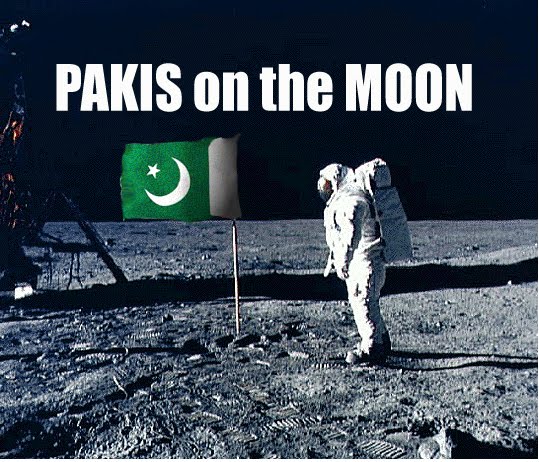
The question is not about whether Pakistan should takes giant leaps in advancing its space program but about whether Pakistan would be economically able to stand in the comity of nations. Is our entrepreneurial spirit so dead that we can’t even imagine the possibility of Pakistan’s space age? Recently I wrote a blog about putting a Pakistani on the


moon. Ludicrous though it sounds, the purpose of that article was to observe the imaginative power and the entrepreneurial zeal of my fellow Pakistani readers. Many blog sites in the Pakistani blogdom refused to even publish that (except for a couple). It makes me wonder if Jules Verne was denied publication rights to Journey to the Moon (a century before the Apollo missions) by the French, just because it was highly ludicrous. It is that imaginative power and spirit – not squabbling over vague religious doctrines – that propels nations to excel in economics, science and technology.

Currently the Pakistani space program comprises of:

- Satellite Development Program Remote Sensing & GIS Applications,

-Space Science,

- Core Technologies Development,


- International Cooperation & Infrastructure Development.

The satellites that are in operation are Pak Sat-1, Pak Sat1-R, and the Badr Series satellites. Suparco has planned to launch an optical imagery satellite soon and a high resolution remote sensing satellite by the year 2014. These plans are integrated within the Space Program 2040, whose purpo


If there is a time for Pakistan to make a giant leap then now is that time. With a stagnant space administration, lack of education and research in space sciences, if we can overcome the institutional barriers to stop us from succeeding there is nothing to stop our minds.se is to present the full benefits of space technology to the nation. As commendable as these steps may be, an active effort still has to be made to make the public aware of these achievements. A crop of scientists and engineers has to be cultivated so that the future growth of Pakistani space program is not moribund. Since Suparco is still dependent on Chinese and Russia

n technology to develop satellite, communication and launch systems, to launch a truly indigenous satellite and space vehicle efforts have to be made to promote s

pace technology in our schools, universities and colleges. If we can build sophisticated weapons of mass destruction, why not use the same technologies in areas of science and technology.

If Pakistan is to survive for a thousand years then the time for developing a comprehensive space exploration strategy is now!

Tuesday, January 31, 2012

The Great Brain Waste

My following article also appeared on Express Tribune Blogs

In May last year an Australian embassy press release stated that more than 5,000 Pakistani students have chosen Australia as their destination to study.

How many of these people actually go abroad to study?

The answer is nil.

Living in Australia, I can say that 99% of these so-called students are actually professionals and underachievers of society who go abroad to seek a better life. Let’s face it: who would want to live in a country where there is daily load shedding, nepotism, corruption, government ineptitude and terrorism, right?

Although this Pakistani talent is moving out in search of greener pastures, the truth is that most of it is being put to use in cutting tomatoes for restaurants, driving taxis and cleaning toilets. This phenomenon is known as brain waste.

According to the Encyclopedia of World Economy , brain waste is defined as the underuse of migrant talent in the host country. In the same encyclopedia, which quotes Ozden’s 2006 study, it is mentioned that the brain use of Pakistani migrants is just 38%

The problem is that the toilet cleaner or that person who chops veggies in restaurants is a highly educated man or woman who might possess a masters or bachelors degree but can’t get a decent job. Misconceptions about race and religion are also important factors for Pakistanis being jobless or being caught in sub-standard jobs in the West.

Another important and closely related problem is the under utilisation of Pakistani talent. This means that even if you get a decent job in a high-rise building abroad, you will still face a barrier during job promotions and other office activities. This talent is being wasted in a foreign country. It should really be put to good use in Pakistan. This is why the brain drain in Pakistan and the subsequent brain waste are co-related. Hundreds of Pakistani doctors, engineers and IT professionals are working in super markets, packaging factories and restaurants abroad.

Many Pakistani students go away merely to secure a nationality. They do not even bother to show up for classes during the semester and appear only at the time of exams. After my recent encounters with some of these students, I realised that most are here in a foreign country to secure a better future for their families by sacrificing their own. Sadly, these people add nothing to the knowledge of the host country and finally become parasites. The labour that could have been done by any other common person is now being done by our doctors, scientists and engineers.

Recently, I met a former government teacher from Punjab who after being frustrated by low salaries moved to Australia to work in a kebabshop. All he wants is to earn enough money to move back to Pakistan and open a restaurant in five years, so that he and his family can live “happily ever after”.

After witnessing the government’s legendary acts of corruption, who can convince that poor teacher not to leave his job and pursue a career which is unsuitable for him? The truth is that Asians generally choose their careers on the basis of a given situation and not their talent. Hence, Pakistan which already faces a shortage of teachers, is short of one more.

Who knows how many other doctors, engineers and scientists will leave Pakistan to be contractors, taxi drivers and restaurant owners at the expense of their true skill?

Unfortunately, these talented and highly skilled individuals will remain unutilised unless something substantial is done to stop this brain waste and restore normalcy in the state of Pakistan.

Number of Visitors